A-A+
A-A+

Information on Food Allergy & Intolerance

Some individuals may experience adverse reactions to specific allergens present in food. The food industry, consumers, and the government can work together to safeguard individuals from food allergens.

Overview

Contents in this page

      What are food allergies?

      Food allergies occur when our immune system mistakenly identifies a normally harmless food protein as a threat. This triggers an exaggerated response, where the body releases antibodies and chemicals, such as histamine, to combat this perceived 'invader.'

      Histamine plays a key role in allergic reactions, causing symptoms like itching and swelling. 
      icon-accordion-down

      Food allergies are mainly categorised into three types:

      Foodallergen Foodallergytypes

      icon-accordion-down
      People with allergies react specifically to certain food allergens. Hence, symptoms of food allergies can vary widely. They may appear almost immediately or take several hours to manifest, depending on the type of allergy and individual sensitivity.

      Symptoms range from mild irritation to severe, life-threatening reactions such as anaphylaxis.

      Anaphylaxis is a whole-body reaction that requires immediate medical attention, as it can impair breathing, drastically lower blood pressure, affect heart rate, and lead to unconsciousness. If not promptly treated with an emergency epinephrine shot, it can be fatal.

      Common symptoms of food allergy include:

      • tingling or itching in the mouth 
      • skin rash, itching, hives
      • stomach pain, vomiting, diarrhoea
      • dizziness and feeling light-headed
      • swelling of the eyes, red eyes, or itchy and/or watery eyes
      • swelling of the lips, tongue or throat; difficulty swallowing
      • chest pain
      • shortness of breath, trouble breathing, wheezing
      • anaphylactic shock 

      How are food intolerances different from food allergies?

      Food allergies involve an immune response, while food intolerances arise from the body's inability to digest certain foods. This may be due to a lack of specific digestive enzymes in the body or irritation to the digestive system caused by substances in the food.

      icon-accordion-down

      Unlike allergies, symptoms of food intolerance typically occur several hours after eating and can last for a prolonged period. The severity of these symptoms often depends on the quantity of food consumed. Symptoms of food intolerance include: 

      • a general feeling of discomfort or illness 
      • bloating and excess gas
      • diarrhoea
      • migraines and headaches
      • nausea
      • palpitations
      • rashes and flushing
      • reflux
      • runny nose
      • stomach pain

      It may be challenging to distinguish between a food intolerance and a food allergy due to overlapping symptoms. Therefore, it is crucial to consult a medical professional for an accurate diagnosis and appropriate treatment.

      What foods cause food allergies and food intolerances?


      The 8 Major Classes of Food Allergens


      Foods that cause hypersensitivity reactions in people are known as food allergens. Currently, there are more than 170 foods that are known to cause allergic reactions.

      Of these, the 8 most common allergens are milk, egg, fish, crustaceans, soya beans, peanuts, tree nuts, and wheat.
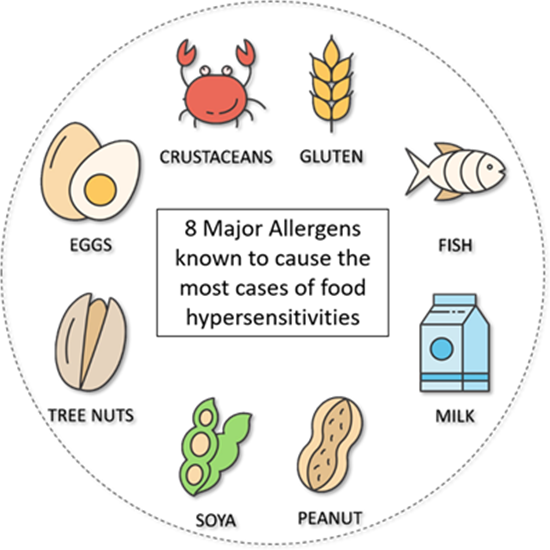
      8 major allergens

      The international food standards-setting body, the Codex Alimentarius Commission Committee on Food Labelling, has recommended that these 8 foods be declared on the labels of pre-packaged foods to protect consumers with allergies.

      Food components commonly associated with food intolerances


      Food components that are commonly associated with food intolerances include:

      • Lactose - found in dairy products such as cheese, ice cream, milk chocolates, candies, bread, baked goods, salad dressing, breakfast cereals and cereal bars.

      • Gluten - found in bread, cakes, crackers, and certain condiments (e.g. soy sauces, Asian marinades and barbecue sauces), and wheat-based pasta.

      • Histamines and amines - found in fermented dairy products such as cheese (especially aged), yogurt, sour cream, buttermilk, fermented vegetables (e.g. sauerkraut, kimchi, pickles and pickled veggies), and cured or fermented meats (e.g. sausages, salami and fermented ham).

      • Monosodium glutamate (MSG) - found in snack foods, seasoning for instant noodles, canned soups, and soup mixes, processed meat (e.g. jerky, sausages and smoked meats), frozen meals and condiments.

      • Artificial sweeteners - found in soft drinks, candies, puddings, chocolate bars, jams and jellies.

      • Galactans - found in legumes such as baked beans, kidney beans, chickpeas and soy-based products.

      How can we prevent allergic reactions to food?

      The food industry, consumers and government all have a part to play in ensuring food safety. To understand more about how each has a part to play, see:

      Industry

      What can the industry do to protect consumers?

      To ensure consumer safety, the industry plays a vital role in managing food allergens throughout the entire food supply chain and production process. 

      Cross-contamination can potentially occur at different stages of the supply chain, such as during harvesting, transportation, handling of ingredients, and manufacturing of food products.

      An effective allergen management programme should form part of a food manufacturer’s Good Manufacturing Practices (GMP). 

      To eliminate cross-contact with allergens, a company should also implement the Hazard Analysis Critical Control Point (HACCP), which is an internationally recognised, science-based, and systematic approach to identifying, evaluating, and controlling any biological, chemical, or physical hazards at each stage of the food supply chain.

      The aim of HACCP is to ensure that safe food is consistently being produced by manufacturers. Some recommended good practices for food manufacturers are highlighted below:
      icon-accordion-down

      It is important for the industry to handle food ingredients in a way that prevents or minimises the presence of unintended allergens.

      Measures should be put in place to assess the presence of unwanted allergens in the ingredients before use. These measures can include the constant review of the practices and operations of suppliers to prevent cross-contamination in the process that may introduce unwanted allergens.

      Suppliers should also adhere to the same standards when sourcing for ingredients.

      icon-accordion-down
      Ingredients that contain known allergens must be stored separately from those that are known to not contain any allergens. Both should be properly labelled and physically segregated if they are stored in the same storage facility. The reuse of containers for allergenic and non-allergenic ingredients should be avoided to prevent contamination.
      icon-accordion-down

      Production schedules should be planned such that the production of products containing known allergens are kept separate from the production of non-allergenic products to prevent contamination. For example:

      • Products containing known allergens could be manufactured at the end of the day or shift.
      • Products containing known allergens could be manufactured consecutively to minimise changeovers.
      • Allergenic ingredients could be added as far downstream as possible in the processing line to minimise equipment used and the contact time between the equipment and the known allergen.
      • Products containing known allergens could be allocated to a separate production line. If the same production line is used, operators should implement a thorough sanitation programme between manufacturing processes to prevent cross-contamination.

      An effective scheduling and sanitation programme not only prevents cross-contamination but also saves on sanitation costs and reduces production downtime for manufacturers.

      icon-accordion-down
      To minimise cross-contamination, tools should be designed such that products or ingredients containing known allergens do not easily get caught in the equipment used.

      For example, welds should be smooth, seals and hoses should not contain cracks, and there should not be ‘dead ends’ in the pipework or other areas, to prevent the accumulation of ingredients in parts of the equipment during the production process.
      icon-accordion-down
      It is also important for the industry to carry out thorough cleaning of food contact surfaces to reduce the risks of allergen cross-contamination. 

      For instance, ‘hard-to-reach’ areas should be dismantled and manually cleaned to ensure they are free from allergen residues.

      Risk assessments can be conducted to identify areas of potential risks of cross-contamination. 

      There should also be procedures in place to ensure effective cleaning practices that will remove allergens after a production cycle , such as the implementation of allergen residue swab testing on food contact surfaces after cleaning or allergen residue testing of Clean-in-Place (CIP) rinse water.

      Any spillage that occurs during processing, storage, or transportation should be cleaned immediately to prevent subsequent cross-contamination.
      icon-accordion-down
      Rework and Work-in-Process (WIP) that contain known allergens should be stored in containers with secured covers in designated areas.

      The containers should be clearly labelled with the types of allergens present. It is important to maintain proper inventories to prevent or minimise the potential for incorporating them into the wrong product.
      icon-accordion-down
      Employees involved in the handling of ingredients, equipment, utensils, packaging, and final products must undergo proper training. 

      Manufacturers should highlight to employees their role in preventing allergen contamination and urge them to take immediate action if any risk of contamination is suspected. 

      Employees should also be sent for retraining to reinforce proper behaviour.
      icon-accordion-down

      Manufacturers should comply with the labelling requirements. For details on labelling, see Labelling Requirements for Food.

      icon-accordion-down

      For effective monitoring and review of the food manufacturing process, food manufacturers must identify the key employees involved and ensure adequate documentation. 

      The allergen management programme should be monitored and reviewed periodically via audits to ensure:

      • Detection and corrective actions taken for any weaknesses identified

      • that the processes and measures remain relevant and up-to-date

      Food manufacturers can adopt these best practices to ensure that its products are safe for consumers with allergies.

      Food Labels

      How food labels help to prevent food allergies

      icon-accordion-down

      Under the Food Regulations, all ingredients and additives used in prepacked food must be declared in descending order of the proportion by weight in which they are present, under the statement of ingredients.

      It is also a requirement under the Food Regulations to declare the presence of ingredients that may cause hypersensitivity in individuals, under the statement of ingredients for pre-packed food products. 

      This includes the declaration of the following food and ingredients in prepacked food products:

      i

      Cereals containing gluten

      This group includes wheat, rye, barley, oats, spelt, their hybridised strains and their products. 

      ii

      Crustacean and crustacean products

      This group includes crayfish, prawns, shrimps, lobsters, crabs, and their products.

      iii

      Eggs and egg products

      This group includes eggs from laying hens, as well as eggs from ducks, turkeys, quails, geese, gulls, and guinea fowls, and their products.

      iv

      Fish and fish products

      This group also includes fish and molluscs, such as oysters, clams, scallops, and their products.

      v

      Peanuts, soybeans and their products

      Peanuts may be declared using similar terms, such as ‘groundnuts’. Terms like ‘soya’ or ‘soy’ can be used for soybeans.

      vi

      Milk and milk products (including lactose)

      This group includes milk from cows, buffaloes, goats, and their products.

      vii

      Tree nuts and nut products

      This group includes almonds, hazelnuts, walnuts, cashew nuts, pecan nuts, Brazil nuts, pistachio nuts, macadamia nuts, and their products.

      viii

      Sulphites in concentrates of 10mg/kg or more

      Food products that have sulphur dioxide and/or sulphites directly added, and/or carried over from food ingredients at a total concentration of 10mg/kg or more (calculated in terms of total sulphur dioxide).

      icon-accordion-down
      Ingredients that may cause hypersensitivity to individuals may be also listed under statements like ‘Allergy information’ or ‘Contains’. 
      icon-accordion-down

      The Food Regulations do not require ingredients known to cause hypersensitivity in individuals to be specially highlighted (e.g. in a separate statement or in bold text) if these ingredients have been clearly declared in the statement of ingredients.

      For example, if the ingredient cuttlefish is already declared in the ingredient list, it would not be necessary to include an additional statement such as "Contains fish" to highlight the presence of cuttlefish in the product.

      The requirement to declare the presence of ingredients that may cause hypersensitivity in individuals does not apply to those unintentionally introduced into foods, for instance, through contamination during manufacturing, transportation, storage, or similar processes.
      icon-accordion-down

      It may not be possible to prevent the accidental presence of allergens during the food manufacturing process.

      To address this issue, Precautionary Allergen Labelling (PAL) has been introduced to inform consumers about the potential risk of allergens inadvertently present in food.

      PAL typically appears on products with statements such as 'May contain [name of allergens]' or 'Produced in a facility that processes products that may contain [name of allergens]'.

      The use of PAL should be:  

      • accompanied by a thorough risk assessment for any actual cross-contamination along the production chain that poses a potential risk to consumers with allergies

      • used only when necessary, as excessive use can limit food choices for consumers with allergies

      Internationally, there is no formal legal definition or framework governing the use of PAL. However, food business operators must ensure that all claims on prepacked food must be truthful and substantiated. 

      Food businesses that use PAL on their products must provide justification if consumers express concerns about potential allergens in their products.

      Consumers seeking clarification on the potential presence of allergens are advised to contact the food business operator directly.

      icon-accordion-down
      In 2007, the Allergen Bureau in Australia and New Zealand initiated the VITAL Programme to provide standardised allergen risk assessment processes for the food industry to determine if the use of PAL is appropriate.

      The VITAL Programme assists food producers in assessing the potential impact of allergen cross-contact in each of their products, and also specifies the precautionary allergen statement that should be used based on the level of cross-contact identified. 

      To date, the VITAL Programme is the most widely adopted precautionary allergen labelling guideline by food industries globally. 

      Food manufacturers interested in finding out more about the programme can visit the Allergen Bureau.

      Consumers

      How consumers can protect themselves from food allergens

      For individuals with food allergies, the best way to prevent an allergic reaction is to avoid consuming food products containing the allergen as an ingredient. 

      Consumers can also follow the tips below:
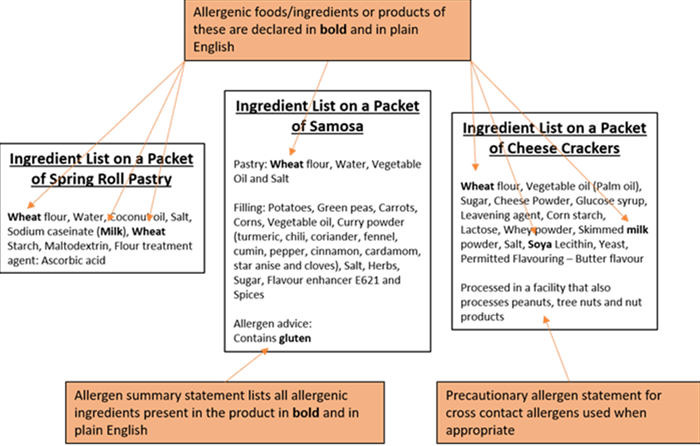
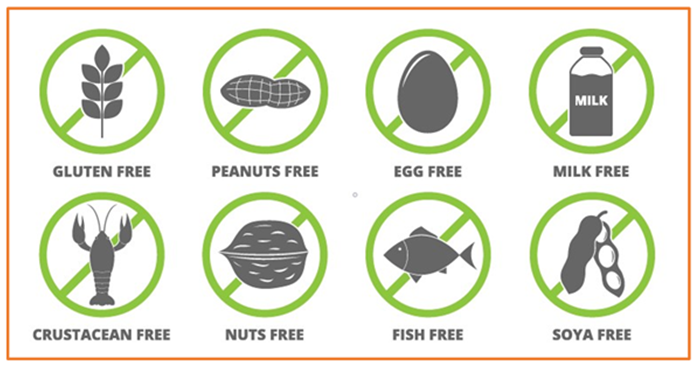
      1. Consumers with food allergies should always check food labels to ensure that the product does not contain the implicated allergen as an ingredient.

      2. Look out for advisory statements such as ‘May contain [allergen]’ or ‘Produced in a facility that also processes [allergen]’. These are used to address potential cross-contamination with allergen residues. Below are some examples of labels that allergic consumers can look out for:

      1. Seek immediate medical attention if you experience symptoms of a severe allergic reaction after consuming food.

      For more information, you may refer to our Risk at a Glance article on food allergies.

      Government

      How SFA protects consumers from allergens


      SFA’s requirements on food labelling

      To protect consumers with food allergies, SFA enforces regulations that require companies to list ingredients on prepacked foods. 

      Under the Singapore Food Regulations, prepacked food products containing food and ingredients known to cause hypersensitivity must be declared on food packaging labels. 
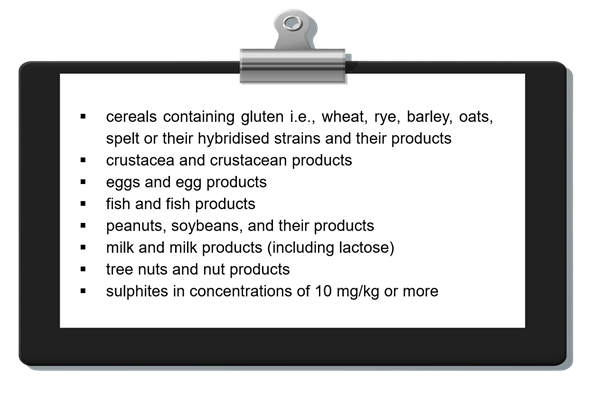
      The following known food allergens must be declared on food labels:

      For more information on our labelling requirements, read our Labelling Requirements for Food.


      Sampling and testing by SFA

      SFA also has in place a food safety regime that involves the sampling and testing of food products sold in Singapore to ensure they meet our regulatory requirements, including checks for the presence of undeclared known allergens.

      SFA adopts a science-based risk assessment and management approach that is consistent with international standards. Food that does not comply with SFA’s food safety requirements will not be allowed for sale in Singapore. 

      When a breach of food safety requirements in food products is detected, SFA will conduct a thorough investigation into the food product. Implicated products may also be recalled as a precautionary measure.


      For more information
      You can contact us via the SFA Online Feedback Form.

      Last updated: 18 Apr 2026